River mile 1
Supply
Rivers, Folsom Lake, wells, and how to find which district pipes water to your address.
Source: each supplier's latest water quality report (2025; West Sacramento 2024, its latest). Bands: USGS. All 13 suppliers below
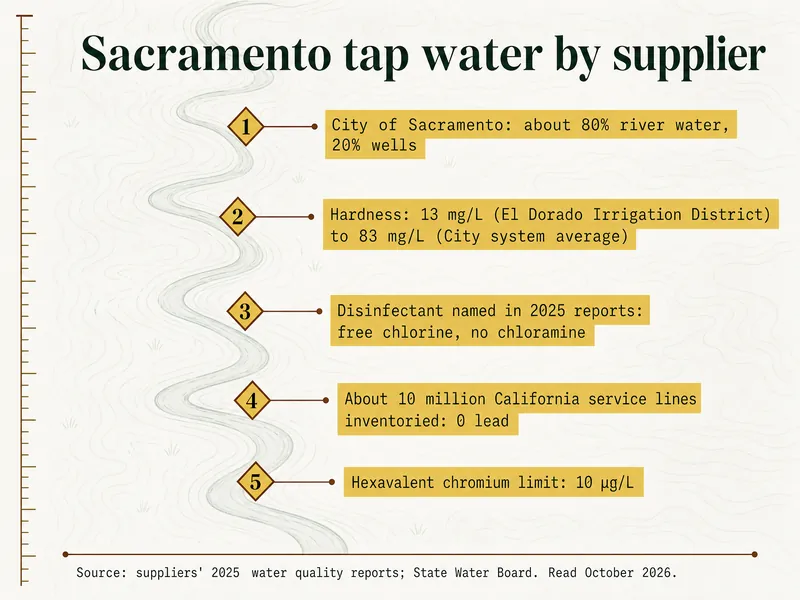
Sacramento tap water changes with the supplier: mainly river- and lake-fed systems report 13 to 83 mg/L of hardness in their latest reports, while well-fed systems run higher, so start with whoever sends your bill.
River mile 0 · Sacramento, Elk Grove, Folsom, Roseville and around
Checked against its sources by Levee Line · how figures are sourced · Last checked
Average total hardness each supplier reports, lowest to highest. Bands follow the USGS scale: soft to 60 mg/L, moderately hard to 120, hard to 180. Several suppliers blend river water and wells, so your tap can sit anywhere between their source figures.
SoftModerately hardHard
Every supplier, with sourcesRiver mile 1
Rivers, Folsom Lake, wells, and how to find which district pipes water to your address.
River mile 4
Service line inventories, pressure regulators, sewer laterals and backflow tests.
River mile 5
Tank life on soft and hard water, SMUD's heat pump rebate, flushing and strapping.
River mile 6
How a metered bill is built, finding leaks on the meter, and rebates open now.
Readings first
Levee Line reads each supplier's own report and quotes it with the year. Reports print hardness and minerals in ppm (mg/L), metals in ppb (µg/L) and PFAS in ppt (ng/L); this site uses the same units.
Most Sacramento tap water is river water. The City of Sacramento treats the American River at the E.A. Fairbairn plant and the Sacramento River at its Sacramento River plant, and tops up with wells for about 20% of supply, according to its 2025 report.
Folsom Lake feeds much of the east side: the City of Folsom, Roseville, San Juan Water District and the agencies it supplies (Citrus Heights, Fair Oaks, Orange Vale), and El Dorado Hills through El Dorado Irrigation District. West Sacramento draws on the Sacramento River, and Davis and Woodland have taken river water through a shared plant since 2016.
Groundwater still matters. Rio Linda/Elverta is 100% wells, and Sacramento Suburban Water District, California American Water's Sacramento systems and Golden State Water's Cordova system blend wells with bought surface water. The supply hub explains each source, and which water district you are in shows how to find yours.

Sacramento tap water ranges from soft to hard depending on the source. On the USGS scale, 0–60 mg/L is soft, 61–120 moderately hard, 121–180 hard and over 180 very hard, a band only some well water reaches here. Lake and river systems sit at the soft end; well water runs higher.
Where a district mixes sources, the tap figure falls between them. At Sacramento Suburban Water District, for instance, the north-area wells average 120 and the south-area wells 130, against 17 to 63 for the river and lake water it buys, so the tap reading moves with the season. Hardness is a scale and soap question, not a health one, per the USGS.
The hardness hub has every district's figure and the softener questions that follow from them.
Usually not for safety: suppliers treat and test the water and publish the results each year, and most homes on river water need no extra equipment. Treatment at home is a choice for taste, scale or a specific result you have reason to act on.
Chlorine is the disinfectant everywhere a supplier names one; the City of Sacramento's 2025 report gives an average residual of 0.8 mg/L. That report also blames the occasional late-summer earthy flavor on two compounds, geosmin and 2-MIB, that ordinary plant treatment leaves in; its advice is to chill drinking water.
Two newer rules are worth knowing. California's hexavalent chromium limit of 10 µg/L took effect October 1, 2024, with compliance dates from October 2026 to 2028 depending on system size. For PFAS, Sacramento County Water Agency reports that four Laguna-area wells above state levels were made emergency-use only and did not serve the system in 2025. The treatment hub covers carbon filters, reverse osmosis and wells.
No lead service lines have been reported in California's inventories: the State Water Board says none were found among nearly 10 million lines, with about 12,000 galvanized lines needing replacement statewide. The City of Sacramento says it has neither lead nor galvanized lines that require replacement.
Unknowns remain in some systems. Rio Linda/Elverta's 2024 inventory lists 3,373 of 4,690 lines as unknown, though none as lead, and West Sacramento wrote in December 2025 to about 8,000 owners whose line material is still unknown. Under EPA's Lead and Copper Rule Improvements, the lead action level drops from 15 to 10 µg/L and systems have 10 years to replace lead pipes once compliance begins on November 1, 2027.
Plumbing inside a house is a separate question from the service line. The lines hub covers service lines, pressure, sewer laterals and backflow testing.
A tank water heater typically lasts 8 to 12 years, according to Rheem, and in California it must be strapped. Health and Safety Code 19211 requires every residential water heater to be braced, anchored or strapped against earthquake motion, and the California Plumbing Code puts the straps in the upper and lower thirds of the tank.
Switching from gas to a heat pump unit has a large rebate in SMUD territory: $3,000 for a 50-gallon tank, $3,500 for 65 gallons and $4,000 for 80, subject to funding, with a permit, a mixing valve and a SMUD network contractor required. ENERGY STAR puts the saving at about $550 a year for a family of four compared with a standard electric heater.
Sacramento freezes are short: NOAA's 1991–2020 normals give Sacramento Executive Airport about 15 nights a year at or below 32°F. Heaters and pipes in garages, attics and outside walls are the ones at risk. The water heaters hub has the rest.
For City of Sacramento customers, the largest is lawn replacement: $2.50 per square foot with a $5,000 single-family cap, open to applications until February 28, 2027. Toilet, irrigation and leak repair rebates sit alongside it, and every program needs approval before work starts.
The bill itself is a fixed meter charge plus a volume charge: $35.72 a month for a 1-inch meter and $1.4587 per CCF of 748 gallons at the City's current rates, with an increase proposed from July 1, 2027. Other suppliers list their programs through the regional Be Water Smart finder. The bills and rebates hub has the full list and the two-hour meter test for leaks.
Readings from the reports
Sounding notes
Sources for this page: 2025 annual reports from Sacramento's city utility, El Dorado Irrigation District, the San Juan Wholesale Customer Agencies, the City of Folsom, Sacramento Suburban Water District, Rio Linda/Elverta Community Water District, California American Water and Sacramento County Water Agency, West Sacramento's 2024 report, the State Water Board's service-line and hexavalent chromium pages, EPA's lead rule page, Health and Safety Code 19211, NOAA's 1991–2020 climate normals, and SMUD, ENERGY STAR, Rheem and City of Sacramento rate and rebate pages, all read in October 2026. Grains per gallon are converted at 17.1 mg/L where a report gives mg/L only. Left out: Elk Grove Water District's figures, because its report could not be opened (read it on the district's site), and any grading of suppliers as safe or unsafe.
Suppliers test it and publish results every year in a water quality report, and that report is the place to check any specific result. This site does not grade suppliers. If a result in your supplier's report concerns you, the treatment hub explains which filters are certified for what.
Geosmin and 2-MIB are the cause the City's 2025 report names for a musty note that shows up most often late in the summer. Standard treatment does not take them out. The City suggests chilling drinking water; a carbon filter is another option.
The City of Sacramento adds fluoride, with a treated average of 0.7 mg/L in its 2025 report, and Roseville and Sacramento County Water Agency also report fluoridation. Davis and Woodland's shared river supply is not fluoridated. Check your own supplier's report.
No 2025 report from a Sacramento-region supplier names chloramine. Every supplier that states a disinfectant uses free chlorine, at averages of roughly 0.6 to 1.4 mg/L in the distribution system.
Some districts run more wells in summer. Carmichael Water District, for example, says its water is soft in winter on American River water and harder from about May to October, when wells run. Sacramento Suburban Water District notes its customers may get surface water, well water or a blend at different times.
Elk Grove has more than one supplier: Elk Grove Water District serves part of the city and Sacramento County Water Agency serves other areas, including Laguna and Vineyard. Elk Grove Water District issues a separate annual report, and its figures are found there. Your bill names your supplier.
Once a year. California suppliers publish a report on the previous year's water each summer; the City of Sacramento's 2025 report was published in June 2026. This site updates figures as new reports appear.
Further down the channel