Water Softener Sizing for Sacramento Homes
Water softener sizing comes down to one multiplication: grains per gallon times people times about 75 gallons a day, which for most Sacramento-area homes points to the smallest common size, 32,000 grains.
Checked against its sources by Levee Line · how figures are sourced · Last checked
Ownership note: Levee Line shares its owners with SoftPro Water Systems and Quality Water Treatment, the two stores this page links to. Figures on this page come from Sacramento-area suppliers' own 2025 water quality reports, California and federal rules and certifiers' listings, read in October 2026. Anything a store says about its own product is reported as the store's claim. How store links work here
Readings first
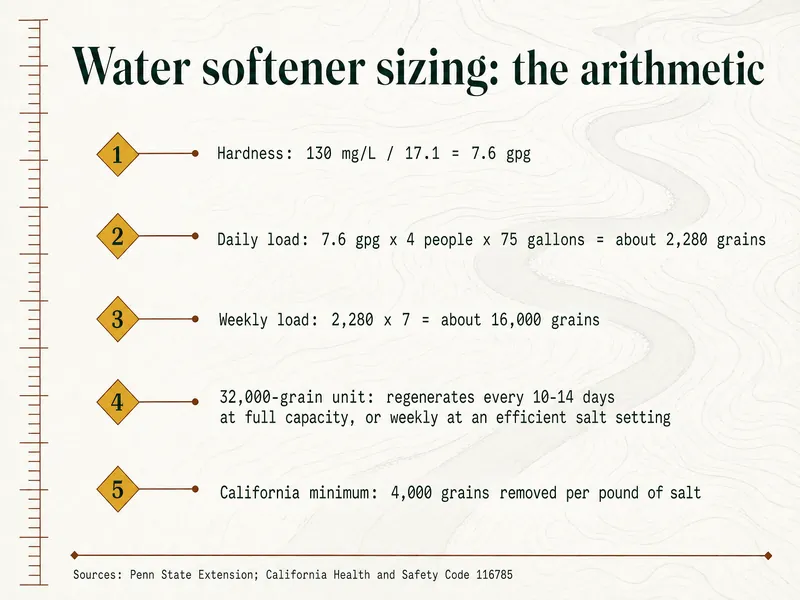
- Daily softening load = hardness in gpg × household size × roughly 75 gallons each, the same water-use figure Penn State Extension uses in its example.
- Aim for roughly one regeneration a week: weekly load = daily load × 7.
- Four people on 130 mg/L (7.6 gpg) well water need about 2,280 grains a day, or about 16,000 a week.
- Even Cal Am Fruitridge Vista's 172 mg/L (10.1 gpg) average works out to about 21,000 grains a week for four people.
- California requires new softeners to regenerate on demand and remove at least 4,000 grains per pound of salt (Health and Safety Code 116785).
- Softener listings from both stores run from 32,000 to 64,000 grains.
How do you work out water softener sizing?
Multiply three numbers: hardness in grains per gallon, the number of people, and about 75 gallons per person per day. The 75 gallons is an assumption, not a measurement of your home; Penn State Extension's worked example uses it ("75 gallons (10 gpg) x 4 = 3,000 grains per day") and then divides a 20,000-grain capacity by that load to get "about 6-7 day regeneration".
First convert your supplier's figure. Reports print mg/L (ppm); divide by 17.1 for gpg, the conversion California's softener law itself states. Then multiply by 7 for a weekly load and pick a unit whose usable capacity covers about a week. If your household uses noticeably more or less water than 75 gallons each, scale the answer; your water bill shows actual use.
What size softener fits a hard groundwater district?
For most households on the region's hardest supplies, a 32,000-grain unit is enough, with 48,000 grains for large families. Take the worked case at Sacramento Suburban's south-area well average of 130 mg/L (7.6 gpg), from its 2025 report: 7.6 × 4 × 75 ≈ 2,280 grains a day, about 16,000 a week.
A 32,000-grain unit at full rated capacity would regenerate only about every 10 to 14 days on that load. Run at a more economical salt setting, which yields fewer grains per regeneration, it lands near once a week. At Cal Am Fruitridge Vista's 172 mg/L (10.1 gpg), four people need about 21,200 grains a week, still inside a 32,000-grain unit's weekly reach; six people need about 31,800 grains a week, the whole capacity of a 32,000-grain unit, so a 48,000-grain unit leaves more room.
Sacramento Suburban's water also changes with the supply mix: its hard-water page says customers may get surface water, groundwater or a blend. Set the hardness dial for the well figure and the unit simply regenerates less often on softer months.
Sizing inputs from the sources
- 75 galWater use per person per day in Penn State's worked examplePenn State Extension
- 17.1mg/L in one grain per gallonCalifornia Health and Safety Code 116780
- 130 mg/LSSWD south-area well average (51–280)Sacramento Suburban Water District 2025 CCR
- 10.1 gpgCal Am Fruitridge Vista average, the region's hardest systemCalifornia American Water
What size for moderate hardness?
The smallest size sold covers it with room to spare, and on soft lake water no softener is needed at all. Four people on the City of Sacramento's 83 mg/L (4.9 gpg) average need about 1,470 grains a day, roughly 10,300 a week, per the City's 2025 report; a 32,000-grain unit would last about three weeks between regenerations at full capacity.
Golden State Water's Cordova system averages 75 mg/L but ranges from 25 to 270 mg/L. In a blended system like that, test your own tap with a hardness strip in summer and winter before setting a softener. Whether you want one at this hardness at all is the question on do you need a water softener.
How does flow rate change softener sizing?
Grain capacity sets how long a unit runs between regenerations; flow sets whether it can keep up when several taps run at once. Too small a tank for your peak flow lets hard water slip through during heavy use, so check the listing's service flow against a busy morning in your home.
On private wells the pump sets the pace. The stores size their well softeners by pump gallons per minute: SoftPro's Elite softener for well water (sold by SoftPro Water Systems, which shares Levee Line's owners) ($1,327–$3,367) is sold as softener only, with a KDF stage, or with an Iron Master iron filter, and Quality Water Treatment's SoftPro ECO Well Water Softener (sold by Quality Water Treatment, which shares Levee Line's owners) runs $947–$2,977 (each store's listed price in October 2026). An iron stage only makes sense if a lab test shows iron: see well water treatment and private well testing.
How often should a softener regenerate?
About once a week is the target this site uses, matching Penn State's 6-to-7-day example. Much more often wastes salt and water on each cycle; much less often means the resin sits loaded for long stretches.
California settles the timing question for new units: Health and Safety Code 116785 requires demand control, so the softener regenerates when a meter or sensor says the resin is nearly spent, not on a fixed clock. Penn State notes that timed models "will waste more water and salt because they regenerate whether the resin needs it or not."
What does California require of softener efficiency?
A new softener that discharges to the sewer must be certified at 4,000 grains or more of hardness removed per pound of salt and must use demand-initiated regeneration. The same section requires faucet and shower flow restrictors and unsoftened water at the hose bibs.
That rating turns sizing into a salt estimate. Removing 16,000 grains a week at 4,000 grains per pound takes about 4 pounds of salt a week. Woodland's softener FAQ treats more than 50 pounds a month for four people as a sign of waste. For city water, SoftPro lists the SoftPro Elite Smart HE (sold by SoftPro Water Systems, which shares Levee Line's owners) at $1,367–$2,827 and Quality Water Treatment the SoftPro ECO City softener (sold by Quality Water Treatment, which shares Levee Line's owners) at $967–$2,677, both offered from 32,000 to 64,000 grains (listed prices in October 2026).
Sounding notes
The sizing rule (gpg × people × about 75 gallons a day, about one regeneration a week) follows Penn State Extension's Water Softening article. Hardness inputs come from 2025 supplier reports (City of Sacramento, SSWD, Golden State's Cordova system, Cal Am), read in October 2026. Efficiency rules are from California Health and Safety Code 116780 and 116785; Woodland's FAQ gives the salt benchmark. Prices and sizes reflect the store listings in October 2026. Left out: brand-specific salt-setting capacities, which vary by control valve, and any operating-cost promise.
Downstream questions
Is a bigger softener always better?
No. An oversized unit regenerates rarely, which leaves resin loaded for long periods, and costs more up front. Aim for about a week between regenerations at an efficient salt setting.
How many grains does a family of two need on Sacramento Suburban well water?
At the south-area well average of 7.6 gpg, two people at 75 gallons each use about 1,140 grains a day, about 8,000 a week. The smallest common size, 32,000 grains, covers that comfortably.
Do I size for the average or the maximum hardness?
Size for a figure close to what reaches your tap in its hardest season. Where a supplier's wells run up to 240 or 280 mg/L, a home test in summer tells you whether your street actually sees those readings.
Does iron change softener sizing?
It can. Iron loads the resin too, which is why well listings bundle a separate iron stage; size and choose that stage only after a lab report shows iron.
Can I use the same size for a vacation home?
Lower occupancy means a lower daily load. Set the household size the unit is told to expect so demand control matches real use.
Where do I find gallons per day for my home?
Your water bill reports use in CCF on City of Sacramento accounts; 1 CCF is 748 gallons. Divide a month's gallons by days and people to replace the 75-gallon assumption.
Further down the channel

Back upstream: Sacramento tap water, supplier by supplier