Are Salt-Free Water Conditioners Worth It?
Salt-free water conditioners can reduce scale but do not soften: the calcium and magnesium stay in the water, so they suit moderate Sacramento water better than hard well supplies above about 120 mg/L.
Checked against its sources by Levee Line · how figures are sourced · Last checked
Ownership note: Levee Line shares its owners with SoftPro Water Systems and Quality Water Treatment, the two stores this page links to. Figures on this page come from Sacramento-area suppliers' own 2025 water quality reports, California and federal rules and certifiers' listings, read in October 2026. Anything a store says about its own product is reported as the store's claim. How store links work here
Readings first
- University of Nebraska–Lincoln Extension says no-salt technologies such as template assisted crystallization "do not remove the hardness".
- The same publication finds "few conclusive studies" confirming how well they work in homes, and says standards for no-salt devices were still in development.
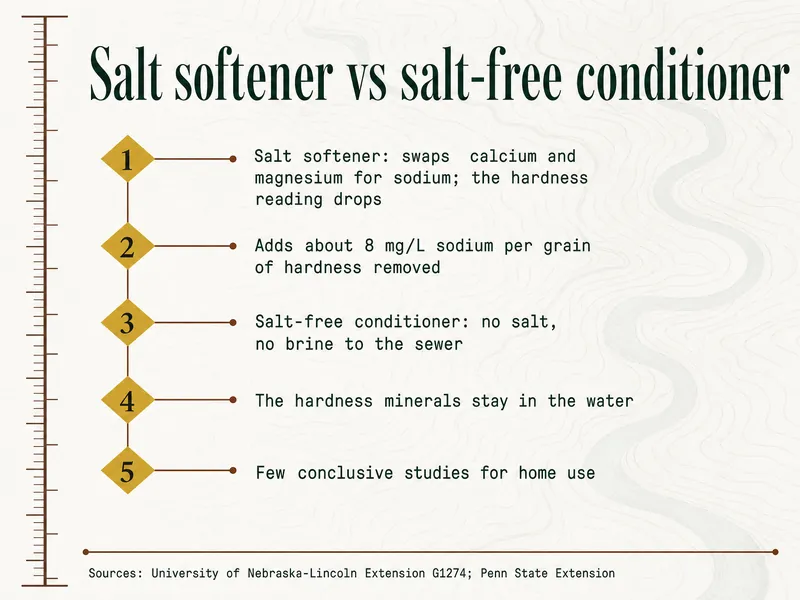
- A salt softener adds about 8 mg/L of sodium per grain of hardness removed; a salt-free conditioner adds none and sends no brine to the sewer.
- On the City of Sacramento's 83 mg/L (4.9 gpg) average, scale builds slowly, which is where a conditioner's modest job fits best.
- Where Cal Am wells run hardest (Parkway averages 166 mg/L, Fruitridge Vista 172), a salt softener gives a result you can measure.
- SoftPro and Quality Water Treatment list salt-free conditioners at $229 to $1,299 (listed prices in October 2026).
What does a salt-free water conditioner do?
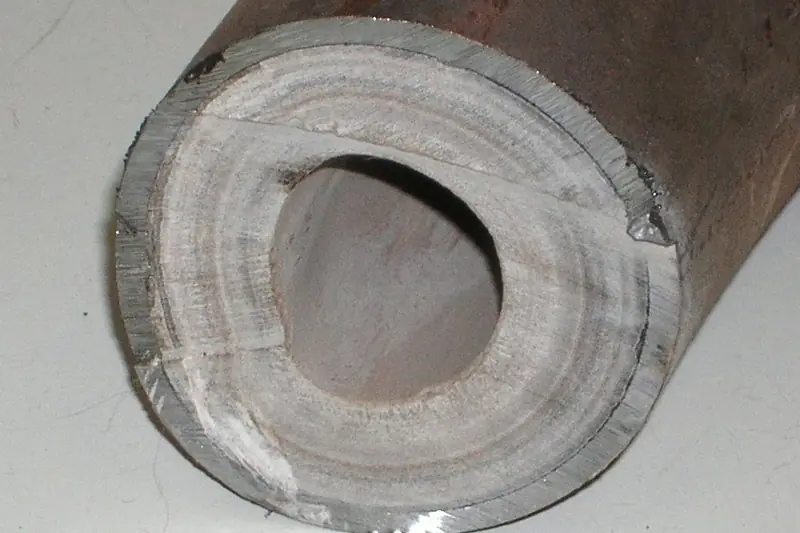
It tries to keep hardness minerals from sticking as scale, without taking them out of the water. A common type is template assisted crystallization (TAC); sellers describe the media as turning dissolved hardness into tiny crystals that ride along in the water instead of coating pipes and heater elements.
Nebraska Extension groups TAC with magnetic water treatment and other "nonchemical technologies based on a variety of physical phenomena", and states plainly that "These technologies do not remove the hardness." The stores describe their units the same way in sales terms: SoftPro says its Elite salt-free conditioner (sold by SoftPro Water Systems, which shares Levee Line's owners) "reduces scale buildup without the use of salt". That is a scale claim, not a softening claim.
Is a salt-free conditioner a water softener?
No. A softener removes calcium and magnesium by ion exchange, so a hardness test after the softener reads near zero; after a conditioner it reads the same as before. Quality Water Treatment's listing title calls its unit a salt-free "softener" (sold by Quality Water Treatment, which shares Levee Line's owners), but strictly it is a conditioner.
The difference matters for what you notice. USGS ties soap scum to calcium reacting with soap, and with a conditioner the calcium is still there. Expect less crust inside the water heater at best, not the slippery feel or spot-free glass that softened water gives.
When are salt-free water conditioners worth it?
They make the most sense where hardness is moderate, the main worry is scale in the heater and fixtures, and you want no salt, no brine and no added sodium. City of Sacramento water at 83 mg/L, Golden State Water's Cordova average of 75 mg/L and Woodland's 69.4 mg/L all fit that description.
They also suit households that do not want to haul salt or run a drain line, and places where cities ask residents to cut salt discharge: the City of Woodland's softener FAQ warns against "needlessly discharging excess salt to the environment". Because the evidence is thin, treat a conditioner as an optional extra, not a fix you can verify with a test strip.
On the soft supplies, such as El Dorado Hills at 13 mg/L or San Juan's treated water at 17, neither device is worth buying. The supplier list is on Sacramento water hardness by district.
Numbers behind the choice
- 8 mg/LSodium a salt softener adds per gpg it removesUniversity of Nebraska–Lincoln Extension
- 83 mg/LCity of Sacramento average: moderate, conditioner territoryCity of Sacramento 2025 CCR
- 166 mg/LCal Am Parkway average, where a salt softener's result showsCalifornia American Water
- 0Hardness removed by TAC or magnetic devicesUniversity of Nebraska–Lincoln Extension
When does a salt softener make more sense?
On hard groundwater, roughly above 120 mg/L (7 gpg), and whenever you want a result you can measure. Cal Am Parkway and Fruitridge Vista average 166 and 172 mg/L in their 2025 reports, and Sacramento Suburban's south-area wells average 130 mg/L with readings up to 280; a softener brings those down to near zero.
Ion exchange is the method Penn State Extension describes in detail, and California sets efficiency rules for it: new sewer-discharging units must regenerate on demand and reach at least 4,000 grains per pound of salt under Health and Safety Code 116785. Sizing one is covered on water softener sizing, and the yes-or-no question on do you need a water softener.
What upkeep do salt-free water conditioners need?
Less than a softener: no salt to add, no regeneration cycle and no drain connection. What remains is replacing the media or cartridge on the maker's schedule, and checking the unit's flow rating against your home's peak use.
The listings differ on format. SoftPro's FORTRESS salt-free conditioner (sold by SoftPro Water Systems, which shares Levee Line's owners) ($229–$1,259) comes as a Home cartridge model rated at 6 gallons per minute, a Pro model at 10 and a commercial size, while the SoftPro Elite salt-free unit is a $1,299 tank (Quality Water Treatment lists the same price); all prices as listed by the stores in October 2026. A conditioner is not a filter: it does nothing for chlorine taste, lead or nitrate. For those, see what to filter in Sacramento water.
How do you judge a conditioner's claims?
Ask what the device does to scale, how that was measured and by whom, and ignore claims that go beyond scale. Nebraska Extension notes that standards and protocols for no-salt devices were still in development when it last revised its publication in 2016, so a listing that cites a recognized third-party scale-reduction test is stronger than one that cites none.
Treat health and "beneficial minerals" language as marketing; hardness is "not a health concern", in USGS's words, either way. Judge results by what you can see: compare heater sediment at the next flush with the last one, following flushing and strapping a water heater, and watch fixture crust over a few months.
Sounding notes
How salt-free and magnetic devices work, and the state of the evidence, come from University of Nebraska–Lincoln Extension publication G1274 (revised May 2016); ion exchange and sodium from Penn State Extension and the same Nebraska publication. Hardness figures are from the 2025 reports of the City of Sacramento, Sacramento Suburban Water District, Golden State Water and California American Water, plus Woodland's and EID's 2025 reports, read in October 2026. Store descriptions are reported as the stores' own claims; their health and mineral claims are left out. No device was tested for this page.
Downstream questions
Will a salt-free conditioner stop spots on shower glass?
Probably not much. The calcium stays in the water, and spots form when hard water dries on glass, so wiping or a squeegee still matters.
Can I use a salt-free conditioner on a private well?
Check the listing first: conditioner media can be fouled by iron, manganese or sediment. A lab test of the well comes before any equipment choice.
Does a salt-free conditioner add sodium to drinking water?
No. With no salt brine and no ion exchange, it adds no sodium; a salt softener adds about 8 mg/L per grain per gallon removed.
How long does conditioner media last?
It varies by maker, water use and water quality. Follow the replacement interval in the unit's manual or listing rather than a general rule.
Is a conditioner better for the environment than a softener?
It sends no brine to the sewer, which is the concern Woodland raises about heavy salt use. Whether it does enough for your scale is the trade-off.
Can a salt-free conditioner and a softener be combined?
There is little reason to: a softener already removes the hardness the conditioner would treat. Pick one based on your supplier's hardness figure.
Further down the channel

Back upstream: every Sacramento-region tap water reading