Sacramento Service Line Inventory: Lead and Galvanized
The Sacramento service line inventory found no lead lines: the City of Sacramento reports none, and California's statewide count of about 10 million lines lists zero lead, though some suppliers still show unknowns.
Checked against its sources by Levee Line · how figures are sourced · Last checked
Readings first
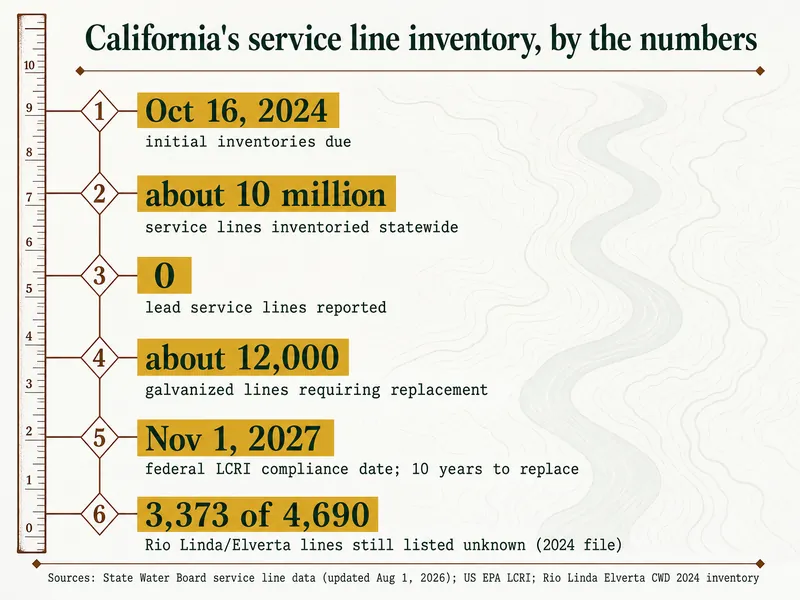
- California water systems had to file a first inventory of every service line by October 16, 2024, under the federal Lead and Copper Rule Revisions (State Water Board).
- Statewide, nearly 10 million lines were inventoried, no lead lines were reported, and about 12,000 lines were classed galvanized requiring replacement (data updated August 1, 2026).
- The City of Sacramento says it has no lead service lines and no galvanized lines requiring replacement (City lead FAQ).
- Rio Linda/Elverta's 2024 inventory file still lists 3,373 of 4,690 lines as unknown, with 0 lead.
- Sacramento County Water Agency finished its inventory in March 2026 and aims to identify its remaining unknown lines by 2028.
- Under EPA's Lead and Copper Rule Improvements, the lead action level drops from 15 to 10 µg/L and the compliance date is November 1, 2027.
Inventory readings
- 10 millionService lines in California's inventories (approximate)State Water Board
- 0Lead service lines reported statewideState Water Board
- 12,000Galvanized lines requiring replacement statewide (approximate)State Water Board
- 46,571Lines inventoried by Sacramento Suburban Water District, none leadSSWD 2025 water quality report
- Nov 1, 2027Federal LCRI compliance dateUS EPA
What did the Sacramento service line inventory find?
The Sacramento-area inventories found no lead service lines, though several suppliers still list lines whose material is unknown. The City of Sacramento says it "has confirmed that there are no lead service lines or galvanized service lines requiring replacement" after its systemwide inventory, and its lead FAQ links a service line inventory map you can search by address.
The statewide picture matches. The State Water Board's service line data page (updated August 1, 2026) says that of nearly 10 million lines inventoried in California, no lead lines have been reported. About 12,000 lines were classed as galvanized requiring replacement, and some lines everywhere are still being sorted out.
Neighboring suppliers report the same headline. Sacramento Suburban Water District's 2025 report counts 46,571 lines with "no lead service lines". San Juan Water District says its survey, which included digging up 5,148 service lines, ended in July 2024 with no lead found, and its 2025 report says the same for Citrus Heights, Fair Oaks and Orange Vale. Golden State Water says its Cordova system has no lead or galvanized lines requiring replacement, "including any customer-owned service lines". Lead in solder, faucets and fittings inside the house is a separate question, covered under lead in tap water.
What is a galvanized line requiring replacement?
A galvanized line requiring replacement, or GRR, is a galvanized steel line that sits, or may once have sat, downstream of lead pipe. The State Water Board's definition covers a galvanized customer portion where the upstream portion is lead, was lead, is of unknown material, or cannot be shown never to have been lead. Galvanized pipe can take up lead from upstream and release it later.
Galvanized pipe on its own is not GRR. The state lists galvanized iron or steel "not needing replacement" as non-lead when nothing lead was ever upstream. Systems with records of installs after California's January 1, 1986 lead pipe ban, or lines 4 inches or wider, could classify those lines as non-lead without digging.
Which suppliers still list unknown lines?
Four supplier areas in the region still show unknown or unpublished line materials. An unknown line is not a lead line; the State Water Board's FAQ says systems must treat "lead status unknown" lines as if they were lead until identified and notify those customers every year.
West Sacramento's lead and copper page says the city mailed about 8,000 residents in older neighborhoods in December 2025 and plans to inspect a random share of unknown lines in 2026. Sacramento County Water Agency's Lead Assessment Program page says its inventory missed the October 2024 deadline, was completed in March 2026, and that customers with unknown lines were notified in April 2026. Rio Linda/Elverta's counts come from its 2024 inventory spreadsheet. Not sure who supplies your address? Start with which water district you are in.
How can you check the pipe at your meter?
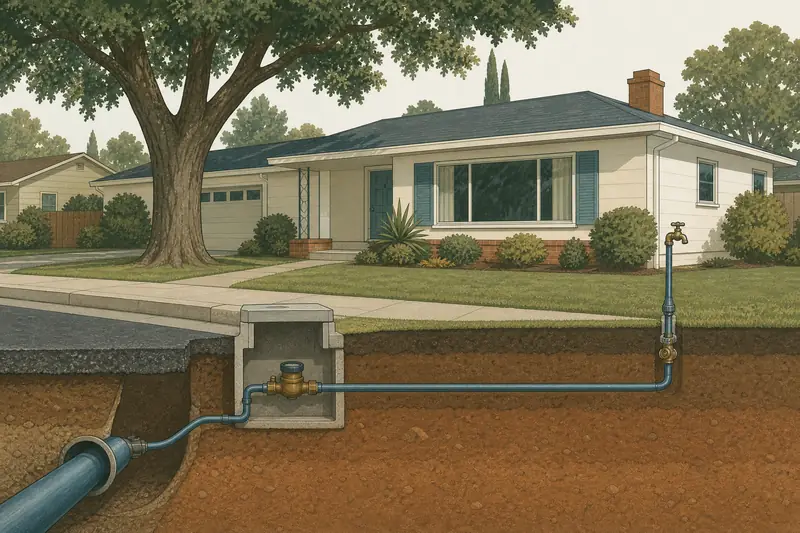
You can usually see the service line where it enters the meter box at the curb or where it comes up into the house near the main shutoff. The State Water Board's inventory FAQ says customers may help with "scratch or magnet tests", and that a record and a photo are what a supplier needs to update its file.
EPA's Protect Your Tap check asks for only a coin or key and a magnet. A magnet sticks to galvanized steel but not to copper, lead or plastic, and a light scratch shows the color of the metal underneath. Look at pipe on the house side of the meter, not the meter body or its couplings.
- Open the meter box lid with a screwdriver and look at the pipe entering on the house side.
- Try a magnet on that pipe, then scratch a small spot with a key.
- Photograph the pipe with the scratch and the magnet in view.
- Send the photo through your supplier's form or map, if it has one. Roseville, Folsom and California American Water all ask for photos or survey answers.
A house first plumbed after January 1, 1986 is classed non-lead by date alone under California's ban, according to the same FAQ. Folsom tells owners of homes built after 1986 that its survey is not needed, and Roseville calls lead in those homes highly unlikely.
Who owns which part of the service line?
In most systems the supplier owns the pipe from the main to the meter, and the property owner owns the pipe from the meter to the house. The State Water Board describes this split and says inventories had to cover both sides. Plumbing inside the house is not part of the inventory at all.
The City of Sacramento's Onsite Design Manual (rev. September 1, 2026) says onsite water systems are "privately owned and maintained, up to the point of service", which the City places at the back of curb or back of sidewalk. Your bill and meter questions sit on Sacramento water bills and meters. If your side of the line is old galvanized pipe, a licensed plumber can tell you whether it is worth replacing for flow or leaks, separately from any lead question.
What does the federal lead rule change by 2027?
EPA's Lead and Copper Rule Improvements, issued October 8, 2024, require systems to replace lead and GRR lines within 10 years of the November 1, 2027 compliance date. EPA's public summary of the rule says the rule lowers the lead action level "from 15 µg/L to 10 µg/L" and has systems with lead lines sample the first and fifth liter at the tap. Reports print these units as ppb (µg/L) and ppm (mg/L); PFAS figures appear in ppt.
For a Sacramento home on a no-lead system, the visible change is mostly paperwork: updated inventories and, where lines are unknown, a yearly notice. The State Water Board expects California's roughly 12,000 GRR lines to be replaced over the decade after 2027. The other street-to-house questions, from water pressure to sewer laterals, are collected on the water lines hub.
Sounding notes
Based on the State Water Board's statewide service line data page (updated August 1, 2026) and its inventory FAQ; EPA's LCRI page, public summary and Q&A; the City of Sacramento lead FAQ and Onsite Design Manual (rev. September 1, 2026); and inventory statements from SSWD (2025 report), San Juan Water District (2025 report and inventory page), Golden State Water Cordova (2025 report), Rio Linda/Elverta (2024 spreadsheet, tallied by Levee Line), West Sacramento (2024 report and lead page) and Sacramento County Water Agency (2026 page), all read October 2026. Left out: Elk Grove Water District, whose report could not be read; Davis line counts, which exist only as a raw address list; and any figure on lead inside home plumbing, which no inventory measures.
Downstream questions
Does an unknown service line mean my house has lead pipe?
No. An unknown line is one whose material has not been confirmed on one or both sides of the meter. California's statewide count shows no lead lines reported, and Rio Linda/Elverta's 2024 file lists 0 lead among its 3,373 unknowns. Systems treat unknowns as lead for notice purposes until they are identified.
Why would a supplier that found no lead send a service line letter?
Suppliers must notify customers whose lines are lead, galvanized requiring replacement or unknown. West Sacramento mailed about 8,000 such letters in December 2025, and Sacramento County Water Agency sent notices in April 2026. A letter usually asks for a photo or allows a crew to look at the pipe.
Can I look up my Sacramento address in the inventory?
City of Sacramento customers can search the City's online service line inventory map by address. Sacramento County Water Agency and California American Water also publish map tools, and Rio Linda/Elverta posts a spreadsheet. Other suppliers publish a summary statement only.
Is galvanized pipe on my side of the meter a problem?
Only galvanized pipe that is or may have been downstream of lead counts as galvanized requiring replacement. Galvanized pipe with no lead upstream is classed non-lead, though old galvanized can still rust, leak or narrow over decades. A licensed plumber can judge its condition.
Does the inventory include the pipes inside my house?
No. The State Water Board says interior plumbing is not part of the inventory, which runs from the main to where the line enters the building. Faucets, solder and fittings inside are covered by tap testing instead.
Who pays to replace a galvanized line requiring replacement?
The federal rule requires systems to replace lead and GRR lines within 10 years of November 1, 2027, but cost sharing for the customer side depends on the supplier and on state and local law. Ask your supplier how it handles the customer-owned portion before hiring anyone.
How long does a supplier have to identify unknown lines?
Sacramento County Water Agency says it aims to finish by 2028, and West Sacramento expected to finish by the end of 2026. Until then, each customer with an unknown line gets a yearly notice, per the State Water Board's inventory FAQ.
Further down the channel
Back upstream: the Levee Line home page with all six folders