Is Sacramento Water Hard?
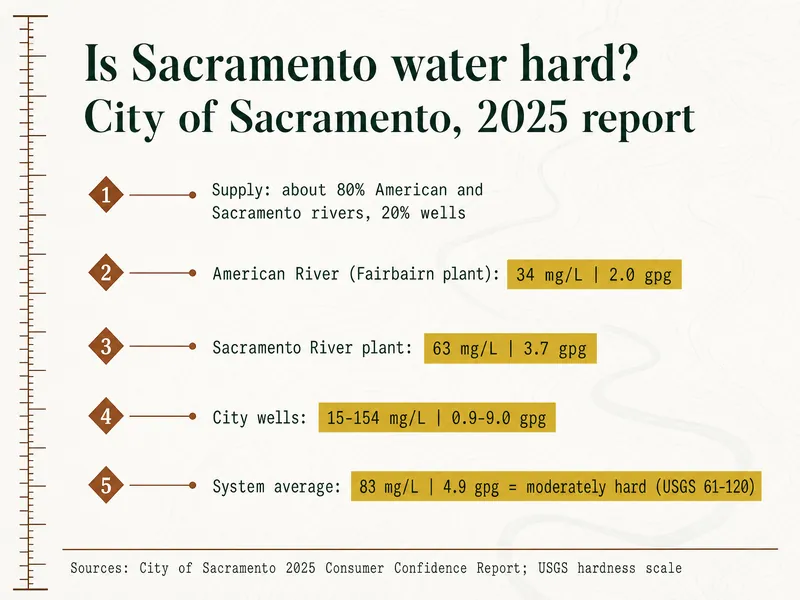
Is Sacramento water hard? Not by much: the City of Sacramento's 2025 report puts its system average at 83 mg/L (4.9 grains per gallon), moderately hard on the USGS scale.
Checked against its sources by Levee Line · how figures are sourced · Last checked
Readings first
- The City's 2025 water report (2025 data, published June 2026) gives a system-average hardness of 83 mg/L, or 4.9 gpg.
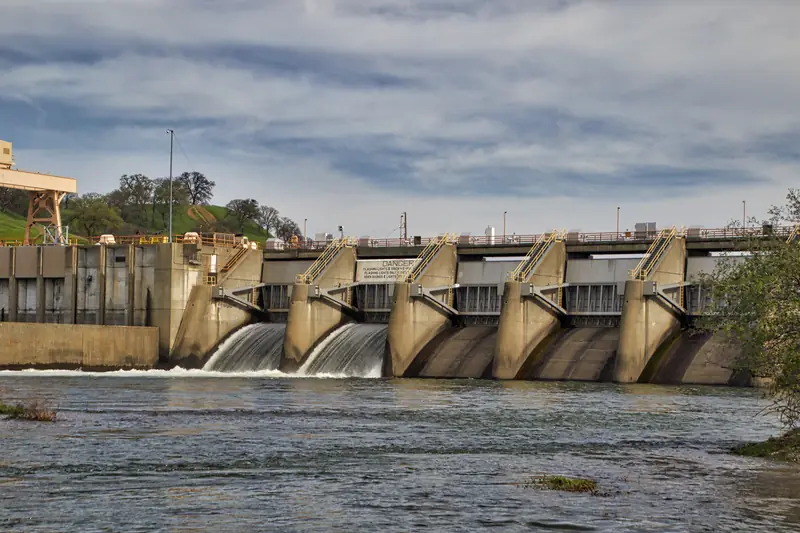
- American River water treated at the E.A. Fairbairn plant measures 34 mg/L (2.0 gpg): soft.
- Sacramento River water from the City's other plant measures 63 mg/L (3.7 gpg), just into the moderately hard band.
- About 20% of City water comes from wells, which read anywhere between 0.9 and 9.0 gpg (15–154 mg/L).
- On the USGS scale, 61–120 mg/L is moderately hard and 121–180 is hard.
- USGS calls hardness "not a health concern, but it can be a nuisance".
How hard is Sacramento water in grains per gallon?
About 4.9 grains per gallon on average, which is 83 mg/L divided by 17.1. That is the City of Sacramento's own system figure for 2023–2025 samples, printed in table 3 of its 2025 report. Reports print hardness in ppm, and 1 ppm is the same as 1 mg/L; trace contaminants appear in ppb (µg/L) and ppt (ng/L).
The average blends three very different sources. About 80% of City water comes from the American and Sacramento rivers and about 20% from groundwater wells, so the number at any one tap depends on which source feeds that part of the system at that time of year.
City of Sacramento, 2025 report
- 83 mg/LAverage hardness across the City system, 4.9 gpgCity of Sacramento 2025 CCR
- 34 mg/LAmerican River water, Fairbairn plant (2.0 gpg)City of Sacramento 2025 CCR
- 154 mg/LHighest City well reading (9.0 gpg)City of Sacramento 2025 CCR
- 20%Share of City supply from groundwater wellsCity of Sacramento 2025 CCR
Why is American River water so soft?
Because it has picked up very little calcium and magnesium by the time it reaches the intakes: the Fairbairn plant's American River water reads 34 mg/L. USGS explains that hardness comes from water dissolving small amounts of minerals as it moves through soil and rock, and the river and lake supplies east of the city all report low figures.
Other suppliers drawing on the same water confirm the pattern. Treated Folsom Lake water from San Juan Water District reads 17 mg/L in the joint San Juan 2025 report, and Folsom's 2025 report gives 26.5 mg/L. Carmichael Water District's American River supply is 25 ppm in its 2025 report, which its report itself calls "soft".
The Sacramento River water is a little harder at 63 mg/L, still near the soft line. The route both rivers take to your tap is traced on where Sacramento tap water comes from.
Why do Sacramento wells run harder?
Groundwater spends far longer in contact with sediments than river water, so it dissolves more of the calcium and magnesium that USGS describes. The City's own wells span 15 to 154 mg/L, from soft to the low end of hard, which shows how much aquifers vary even within one system.
Suppliers that lean on wells report higher numbers still. SSWD's own wells average 120 mg/L in the north service area, per its 2025 report, and 130 in the south, with single readings up to 280. Cal Am's Parkway and Fruitridge Vista systems average 166 and 172 mg/L in reports on its water quality index. Those figures belong to those suppliers, not to City customers.
Is Sacramento water hard in every neighborhood?
No: "Sacramento" covers more than a dozen suppliers, and their reports run from 13 mg/L to 172 mg/L. A home with a Sacramento mailing address might be served by the City, Sacramento Suburban, Cal Am, the Sacramento County Water Agency or Golden State Water, and each publishes its own figure.
Within the City's area, the 2025 report gives only plant, well and system values, not a neighborhood map, so treat 83 mg/L as the City-wide reading. If your street is served by a well field, it may run harder in the months those wells pump. The supplier-by-supplier figures are on Sacramento water hardness by district, and the steps to identify your supplier are on finding your water district.
What does hard water do in a Sacramento home?
At City-average levels, mostly small things: spots on glass, a film on shower doors and slow scale on faucet aerators. USGS lists mineral buildup in plumbing, fixtures and water heaters, and "soap scum" where soap reacts with calcium. When hard water is heated, calcium carbonate drops out, which is why the water heater tends to collect it first.
At 83 mg/L those effects are modest; at 150 mg/L and above, on well-fed systems, they are faster and more visible. Regular tank flushing per your heater's manual helps either way: see flushing and strapping a water heater. Whether the scale justifies equipment is the question on do you need a water softener.
Is hard water a health problem?
No. The USGS page on hardness states that it "is not a health concern, but it can be a nuisance." Hardness is a household-maintenance issue, which is why it appears among secondary or "other" constituents in water reports rather than among health-based standards.
The City's 2025 report lists other figures you may see alongside it: sodium averages 26 mg/L and total dissolved solids 205 mg/L system-wide. Neither is a hardness measure. How the tables fit together is explained on how to read a water quality report.
Sounding notes
Every hardness figure for the City of Sacramento comes from its 2025 Consumer Confidence Report (2025 data, published June 2026), table 3. Comparisons use the 2025 reports of San Juan Water District, the City of Folsom, Carmichael, Sacramento Suburban and Cal Am. The hardness bands and the health statement come from the USGS Water Science School page. All documents were read in October 2026. Left out: neighborhood-level City figures, which the report does not publish, and any claims about skin, hair or appliance life.
Downstream questions
Does City of Sacramento water get harder in summer?
The 2025 report does not give monthly figures. Because about 20% of supply comes from wells ranging up to 154 mg/L, homes nearer well-fed parts of the system may see harder water while those wells run.
Is Sacramento River water harder than American River water?
Yes, by the City's figures: 63 mg/L at the Sacramento River plant versus 34 mg/L at the Fairbairn plant on the American River. Both are well below the USGS hard band.
Is 4.9 grains per gallon considered hard?
It falls in the moderately hard range. On the USGS scale, 4.9 gpg (83 mg/L) sits between soft (up to 60 mg/L, about 3.5 gpg) and hard (from 121 mg/L, about 7.1 gpg).
Why does my kettle scale up if the water is only moderately hard?
Boiling concentrates the calcium carbonate that comes out of solution when water is heated. Even moderately hard water leaves a thin crust over weeks of daily use.
Does West Sacramento have the same hardness as Sacramento?
No. West Sacramento's latest posted report, for 2024, gives an average of 47 ppm from its Sacramento River supply. It is a separate city with its own treatment plant.
Do Sacramento water reports list hardness in grains?
The City's 2025 report prints both mg/L and grains per gallon. Some neighboring suppliers print only ppm; dividing by 17.1 converts it.
Further down the channel

Back upstream: Sacramento tap water, district by district