Do You Need a Water Softener in Sacramento?
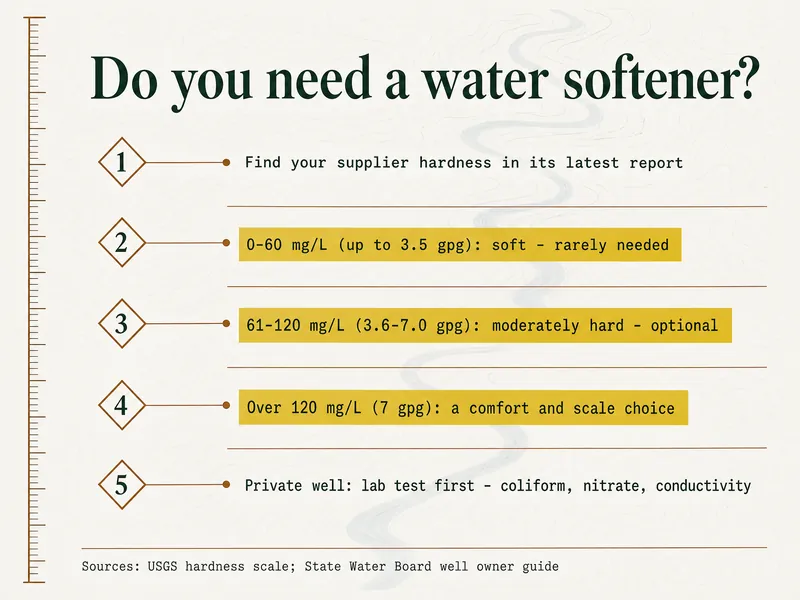
Do you need a water softener in Sacramento? Rarely on river or lake water under 60 mg/L; on groundwater systems averaging above about 120 mg/L (7 gpg), it becomes a reasonable comfort and scale choice.
Checked against its sources by Levee Line · how figures are sourced · Last checked
Ownership note: Levee Line shares its owners with SoftPro Water Systems and Quality Water Treatment, the two stores this page links to. Figures on this page come from Sacramento-area suppliers' own 2025 water quality reports, California and federal rules and certifiers' listings, read in October 2026. Anything a store says about its own product is reported as the store's claim. How store links work here
Readings first
- No Sacramento-region supplier's water needs softening for safety: USGS calls hardness a nuisance, not a health concern.
- Lake-fed suppliers report 13 to 29 mg/L, well inside the soft band, so a softener there buys very little.
- Groundwater-heavy systems report averages of 96 to 172 mg/L (Cal Am) and 120 to 130 mg/L (Sacramento Suburban wells).
- Under state law, any new softener draining to the sewer must regenerate on demand and be certified at 4,000 grains or better per pound of salt.
- Softening adds about 8 mg/L of sodium for each grain per gallon removed, per University of Nebraska–Lincoln Extension.
- Woodland says a household of four using more than 50 pounds of salt a month "could be wasting money".
When does a Sacramento home need a water softener?
Only when the water is hard enough that the scale, spotting or soap film bothers you, which in this region means groundwater above roughly 120 mg/L. A softener is never required for safe drinking water. Start with the figure your supplier prints: the full list is on Sacramento water hardness by district.
On lake and river water the case is weak. El Dorado Hills (13 mg/L), San Juan and Orange Vale (17), Folsom (26.5) and Roseville's lake supply (26) all sit far below the USGS soft limit of 60 mg/L. The City of Sacramento's 83 mg/L average is moderately hard; many homes there run no treatment.
The case is stronger on Cal Am's Parkway (166 mg/L) and Fruitridge Vista (172) systems, on Sacramento Suburban's wells (north 120, south 130) and on private wells, where readings can run well past 200.
What does a water softener actually do?
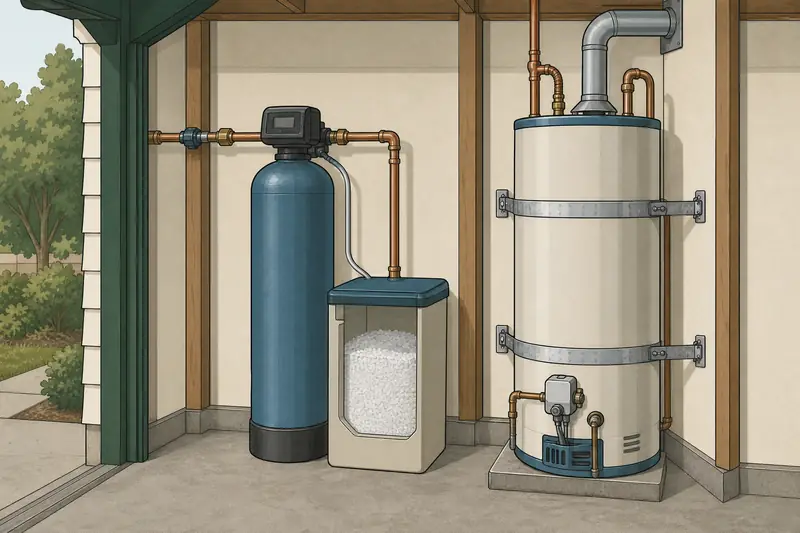
It swaps the calcium and magnesium in your water for sodium (or potassium) on a bed of resin beads, then rinses the beads with salt brine when they are spent. Penn State Extension describes the cycle: hardness ions attach to the resin and loosely held sodium is released, until the softener must run a regeneration cycle.
That is all it does. A softener does not treat bacteria, nitrate, arsenic or chromium 6, and it is not a filter for chlorine taste. On a private well, those questions need a lab test and their own treatment: see well water treatment.
What does a water softener cost to run?
Mostly salt, and the amount follows directly from your hardness and water use. Because new units must be rated at 4,000 grains or more for each pound of salt, a home removing 16,000 grains a week (four people on 7.6 gpg water) uses about 4 pounds of salt a week at that rating, roughly 17 pounds a month.
The City of Woodland's softener FAQ offers a check: "If you are using more than 50 pounds of salt per month for a household of 4 people, you could be wasting money and needlessly discharging excess salt to the environment." An old timer-based unit or a setting far above your actual hardness is the usual cause.
The equipment itself is the larger cost. For city water, SoftPro lists the SoftPro ECO City Water Softener (sold by SoftPro Water Systems, which shares Levee Line's owners) at $967–$2,677 and Quality Water Treatment lists the SoftPro Elite HE for city water (sold by Quality Water Treatment, which shares Levee Line's owners) at $1,367–$2,827 (each store's listed price in October 2026). Sizing is covered on water softener sizing.
What the rules and reports say
- 4,000Minimum grains a new California softener must strip per pound of saltCal. Health & Safety Code 116785
- 50 lbMonthly salt use for a family of four that Woodland calls likely wastefulCity of Woodland softener FAQ
- 8 mg/LSodium added per grain per gallon of hardness removedUniversity of Nebraska–Lincoln Extension
- 172 mg/LHighest system average in the region (Fruitridge Vista)California American Water 2025 report
Are water softeners allowed in California?
Yes, with conditions. Under Health and Safety Code 116785, a softener that discharges to the sewer must regenerate on demand rather than on a timer and be certified at 4,000 grains or more per pound of salt. The install must also include faucet and shower flow restrictors and keep unsoftened water at the hose bibs.
Section 116786 lets a local agency limit or prohibit new installations, but only by ordinance after a salinity study, and it cannot force removal of existing units. No such ordinance turned up for the cities and suppliers checked for this site; the regional sewer agency's site could not be reached, so ask your sewer agency before installing. Davis and Woodland, now on river water, simply ask residents to reconsider: the Davis water FAQ says "consider bypassing it to determine if the current level of hardness in the tap water is acceptable for your home."
What about sodium from a water softener?
Softening adds about 8 mg/L of sodium for every grain per gallon removed, according to University of Nebraska–Lincoln Extension, which credits the figure to the Water Quality Association. Softening 7.6 gpg well water would add roughly 61 mg/L; softening the City of Sacramento's 4.9 gpg average would add about 39 mg/L on top of the 26 mg/L the City already reports.
If you would rather not add it, the same Nebraska publication gives two workarounds: running potassium chloride instead of salt in the brine tank, or leaving a cold-water line to the kitchen tap unsoftened.
What should you try before a water softener?
Read your supplier's latest report first, then try the cheap fixes for a few months. Find which supplier serves you on finding your water district; if it is a lake-fed system, the scale you see is probably light enough for a vinegar soak on shower heads and aerators.
Flush the water heater as its manual directs, since heated water drops calcium carbonate first: see flushing and strapping a water heater. If you already own a softener on river water, Davis's advice applies: bypass it for a while and see whether you miss it.
On a private well, test before buying anything. The State Water Board's well testing page recommends testing for total coliform bacteria, nitrate and electrical conductivity every year, at a certified lab; the steps are on private well testing in Sacramento County. For wells, SoftPro sells the SoftPro ECO Well Water Softener (sold by SoftPro Water Systems, which shares Levee Line's owners) ($947–$2,977) and Quality Water Treatment the SoftPro Elite for well water (sold by Quality Water Treatment, which shares Levee Line's owners) ($1,327–$3,367), sized by pump flow per the listing; both are the stores' listed prices in October 2026. If you want scale control without salt, see salt-free water conditioners.
Sounding notes
Hardness figures come from the suppliers' 2025 water quality reports (West Sacramento: 2024), read in October 2026. The legal points are from sections 116780 to 116786 of the state Health and Safety Code; Woodland's softener FAQ supplies the salt check and the bypass advice from the City of Davis water FAQ. How ion exchange works and the sodium figure come from Penn State Extension and University of Nebraska–Lincoln Extension. Prices are the stores' October 2026 listings. Left out: salt prices, which were not sourced, and any claim about skin, hair or appliance savings.
Downstream questions
Is a water softener worth it on City of Sacramento water?
For most homes it is optional. The City's 2025 figure of 4.9 gpg sits in the moderately hard band, and the scale it leaves is slow; people who dislike spotting on glass or shower doors sometimes add one anyway.
Can a water softener make well water safe to drink?
No. A softener only exchanges hardness minerals. Bacteria, nitrate, arsenic and chromium 6 need testing and treatment designed for them.
Does a softener need a permit in Sacramento?
State law sets the equipment conditions, and the certification paperwork under Health and Safety Code 116795 is filed with the local plumbing-permit agency. Ask your city or county building department what it requires for your address.
Should hose bibs get softened water?
Under Health and Safety Code 116785, new installations must send unsoftened water to hose bibs and sill cocks, with a bypass allowed on some existing slab homes and condos.
Is potassium chloride a direct swap for softener salt?
Nebraska Extension notes potassium chloride can be used to make the brine, though it is less common. Check your softener's manual for the setting change it needs.
What if my supplier's water changes between seasons?
Set the softener for the harder source, or adjust it when the supply changes. Carmichael and Sacramento Suburban both describe tap hardness that rises when wells run.
Further down the channel

Back upstream: Sacramento tap water, supplier by supplier