Sacramento Sewer Laterals and Tree Roots
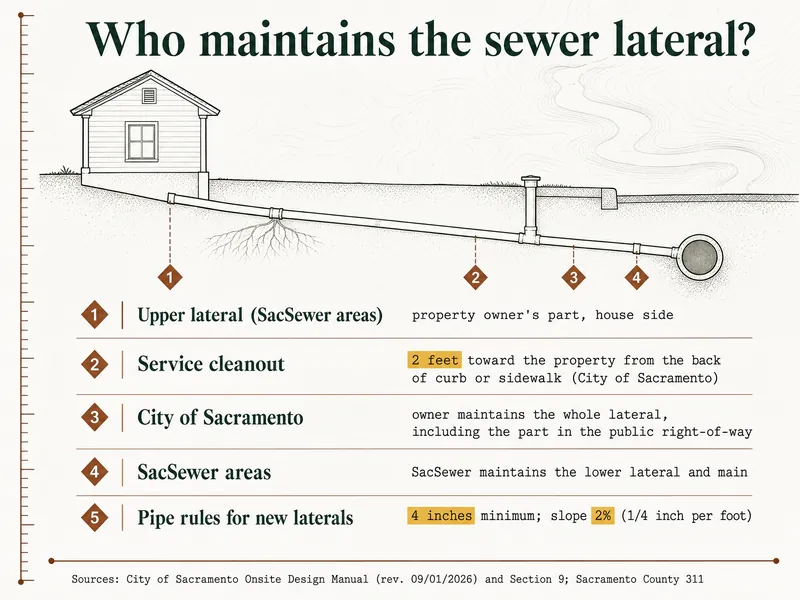
Sacramento sewer laterals belong to the homeowner inside the City of Sacramento, all the way to the main under the street, while SacSewer areas split the pipe into an owner's upper lateral and SacSewer's lower lateral.
Checked against its sources by Levee Line · how figures are sourced · Last checked
Readings first
- In the City of Sacramento, "All onsite sewer systems ... shall be privately owned and maintained, including the portion of the private sewer line located within the public right-of-way" (Onsite Design Manual, rev. September 1, 2026).
- The City's standard service cleanout sits 2 feet toward the property from the back of curb, or from the back of sidewalk where there is no planting strip.
- SacSewer maintains "lower lateral and main line pipes", with the split between upper and lower lateral, according to Sacramento County 311 (updated September 17, 2026).
- SacSewer serves about 1.2 million people and runs about 4,600 miles of sewer pipe.
- New City laterals must be at least 4 inches across, slope at least 2 percent (1/4 inch per foot) and stay 3 feet from trees (City Section 9, January 12, 2024).
- Honolulu's wastewater division says tree roots typically spread about 3 times the width of the branches.
Lateral readings
- 2 ftStandard cleanout distance from back of curb or sidewalk, City of SacramentoCity Onsite Design Manual
- 4 in.Minimum diameter of a new City sewer serviceCity Design and Procedures Manual Section 9
- 2%Minimum slope of a new City sewer serviceCity Design and Procedures Manual Section 9
- 4,600 milesSewer pipe owned and run by SacSewerSacramento County 311
Who owns a sewer lateral in Sacramento?
Inside the City of Sacramento's sewer service area, the property owner owns and maintains the whole lateral, from the house to the City main. The City's Onsite Design Manual (rev. September 1, 2026) says onsite sewer systems are owner-maintained "including the portion of the private sewer line located within the public right-of-way", citing City Code 13.08.020 and 13.08.150. That means the stretch under the sidewalk and street is yours too.
Not every Sacramento address is on the City's sewer. The same manual maps "City and SASD service areas within the City", and much of the region sends sewage through SacSewer instead. Your water supplier is not necessarily your sewer agency; which water district you are in is a separate lookup.
How do SacSewer areas split the lateral?
In SacSewer areas the owner keeps the upper lateral and SacSewer maintains the lower lateral and the main. Sacramento County 311 says SacSewer is responsible for "the local sewage collection system, including lower lateral and main line pipes", with the division "between the upper lateral and lower lateral pipe as shown in SacSewer's Sewer Maintenance Diagram".
SacSewer, formerly the Sacramento Area Sewer District, covers unincorporated Sacramento County, Citrus Heights, Rancho Cordova and Elk Grove, plus parts of Folsom and Sacramento. The County page lists service targets of 2 hours or less to respond to a service call and 4 hours or less to restore service. Levee Line could not open SacSewer's own website while preparing this page, so the exact split point on your lot, any loan program and cleanout rules should come from SacSewer's diagram itself.
Why do tree roots get into sewer laterals?
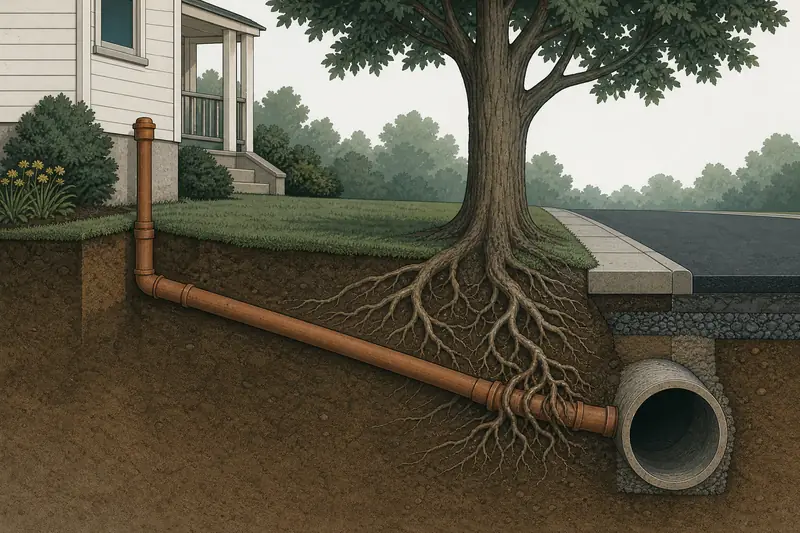
Tree roots get into laterals by following water and air that escape through cracks and loose joints. The City and County of Honolulu's wastewater division puts it plainly: roots "are attracted to water vapor that escapes through pipe cracks or loose joints", then become "entwined with paper, hair, solid matter, and grease" (Honolulu). The same sheet says roots on average extend about 3 times the spread of the branches.
Sources differ on whether roots break sound pipe. Honolulu says growing roots exert pressure that "can result in rupture of the pipe", while the City of Cleveland's urban forestry memo says roots follow leaks rather than cause them and that "removing the tree will not resolve the issue of cracked and broken pipes" (Cleveland). Both point to the same root cause: a joint or crack that already leaks.
Sacramento's older neighborhoods put big street trees and decades-old laterals side by side. The City's Section 9 standard bars new services within 3 feet of trees, which is a useful yardstick when planting near a known lateral.
What does a sewer cleanout do?
A sewer cleanout is a capped riser that gives straight access into the lateral so it can be cleared toward the main. The City's Section 9 says "All Services shall have Cleanouts for cleaning in the direction of the Main", and that the cleanout "is owned by the Customer and utilized by the City for maintenance purposes".
The City's standard spot for the service cleanout is 2 feet toward the property from the back of curb where there is a planting strip, otherwise 2 feet in from the back of sidewalk. Where a backwater valve is required, the City puts it upstream of the cleanout, outside the right-of-way, "maintained by the property owner". Know where your cap is before a backup, and keep it clear of new paving or planting.
What are the signs of a blocked sewer lateral?
Several drains backing up or gurgling at once is the main sign that the blockage is in the lateral or main rather than one fixture. The City of Roseville's sewer problem page lists "Multiple drains backing up at the same time", "Gurgling toilets or drains", "Water coming up through floor drains" and "Sewage backing up in tubs or showers" as reasons to call it before hiring anyone. Roseville says it will "Check the City sewer main" and assess the problem "at no charge".
One slow sink alone points to that fixture's trap or branch line instead. City of Sacramento residents can report sewer problems through 311, and SacSewer areas go to SacSewer, so the agency can rule its own pipe in or out first.
When should a sewer lateral be inspected?
No Sacramento-region rule found for this page requires a lateral inspection at sale or on a schedule, so timing is the owner's call. Cleveland's memo suggests snaking a root-prone line "every 12-18 months" and warns that owners "usually don't have any clues" until a backup. A camera inspection by a licensed plumber or sewer contractor shows root intrusion, offset joints and sags before they become a backup.
Reasonable times to look: before buying an older home with large trees near the line, after a backup has been cleared, and before replacing a driveway or walkway that sits over the lateral. Work on the lateral itself may need a permit, and in City areas the stretch from the cleanout to the main follows City Code 13.08. The water side of the same street-to-house run is covered on service line inventories, and the rest is collected on the Lines and pipes hub.
Sounding notes
Based on the City of Sacramento Onsite Design Manual (rev. September 1, 2026) and Design and Procedures Manual Section 9 (January 12, 2024); Sacramento County 311's SacSewer answer (updated September 17, 2026); the City of Roseville's sewer problem page; the City and County of Honolulu's root sheet; and the City of Cleveland urban forestry memo on roots, all read October 2026. Left out: SacSewer's own diagram, loan program and cleanout rules, because its site could not be opened from here; repair prices; and root-killing products or chemicals.
Downstream questions
Is the sewer pipe under the sidewalk the City of Sacramento's responsibility?
No. The City's Onsite Design Manual says the owner maintains the private sewer line including the part within the public right-of-way. The City maintains its main.
Does SacSewer fix the whole lateral in Elk Grove or Rancho Cordova?
No. SacSewer maintains the lower lateral and main, and the owner keeps the upper lateral, per Sacramento County 311. Where one ends and the other starts is shown on SacSewer's maintenance diagram.
Will cutting down a tree stop roots in the sewer line?
Not by itself. Cleveland's urban forestry memo says removing the tree will not fix cracked or broken pipe, and roots enter through joints that already leak. The fix has to reach the leaking joint itself.
How far do tree roots spread from a tree?
Honolulu's wastewater division says roots extend on average about 3 times the spread of the branches. The City of Sacramento keeps new sewer services at least 3 feet from trees.
Who owns the sewer cleanout in Sacramento?
In the City of Sacramento, the customer owns the cleanout and the City uses it for maintenance, per Section 9 of its design manual. Its standard spot is 2 feet in from the back of curb or sidewalk.
What should a Sacramento homeowner do first when several drains back up?
Contact the sewer agency first: 311 in the City of Sacramento or SacSewer in its areas. Roseville customers can call the City, which says it checks its main at no charge. If the main is clear, the blockage is on the private lateral.
Is a backwater valve required on Sacramento laterals?
Only where the City requires one, and then it goes upstream of the cleanout, outside the right-of-way, maintained by the owner. Section 9 does not require one on every home.
Further down the channel



Back upstream: the Levee Line home page with all six folders