Where Does Sacramento Tap Water Come From?
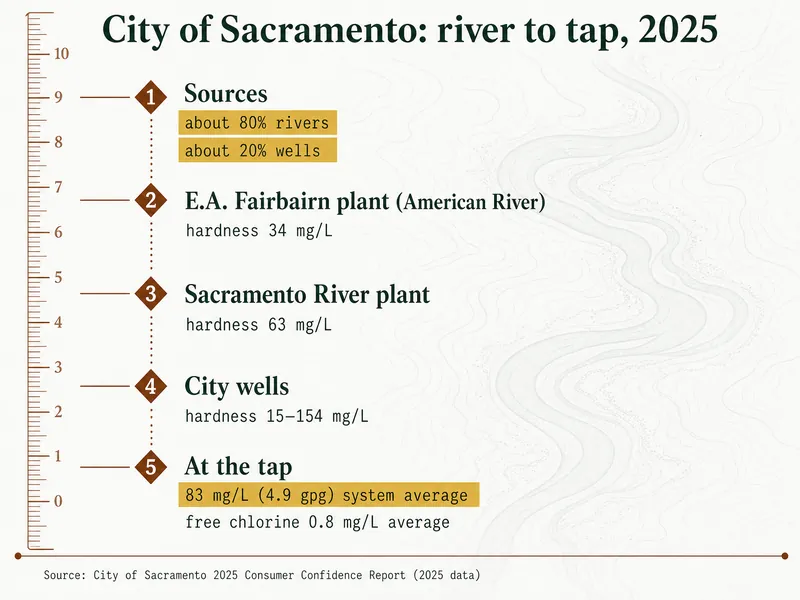
Where does Sacramento tap water come from? About 80% comes from the American and Sacramento rivers and about 20% from city wells, according to the City of Sacramento's 2025 water quality report.
Checked against its sources by Levee Line · how figures are sourced · Last checked
Readings first
- The City of Sacramento's 2025 Consumer Confidence Report (2025 data, published June 1, 2026) puts the split at about 80% river water and 20% groundwater.
- Two plants treat the river water: E.A. Fairbairn on the American River and the Sacramento River Water Treatment Plant north of downtown.
- Hardness differs by source: 34 mg/L (2.0 gpg) from Fairbairn, 63 mg/L (3.7 gpg) from the Sacramento River plant and 15–154 mg/L (0.9–9.0 gpg) from city wells; the system average is 83 mg/L (4.9 gpg).
- The disinfectant is free chlorine, averaging 0.8 mg/L in the distribution system (range 0.2–1.4); the report lists no chloramine.
- An earthy or musty taste in late summer comes from geosmin and 2-MIB, which the report says conventional treatment does not remove.
- The State Water Board's Drinking Water Watch lists 527,979 residents on the City system.
City of Sacramento water, 2025
- 80%of supply from the American and Sacramento riversCity of Sacramento 2025 CCR
- 83 mg/Lsystem-average hardness (4.9 gpg), 2023–2025 samplesCity of Sacramento 2025 CCR
- 0.8 mg/Laverage chlorine residual in the pipes, 2025City of Sacramento 2025 CCR
- 527,979residents served, per the state's system recordState Water Board Drinking Water Watch
Which rivers does Sacramento tap water come from?
Sacramento tap water comes mainly from the American River and the Sacramento River, which together supply about 80% of the City's water; groundwater wells supply the other 20%. That split is printed on page 2 of the City of Sacramento's 2025 water quality report, which covers 2025 data and stays current until June 2027.
The two rivers meet downtown, but the City draws from each separately. American River water arrives from the east, released from Folsom Lake; Sacramento River water comes down from the north. The report notes that both rivers are vulnerable to contaminants from recreation, and the Sacramento River also to agricultural runoff, which is why the water is treated before it reaches you.
If you live outside City limits, your water may come from the same rivers, from Folsom Lake, or mostly from wells. The district finder page sorts that out by supplier.
What happens at the Fairbairn and Sacramento River plants?
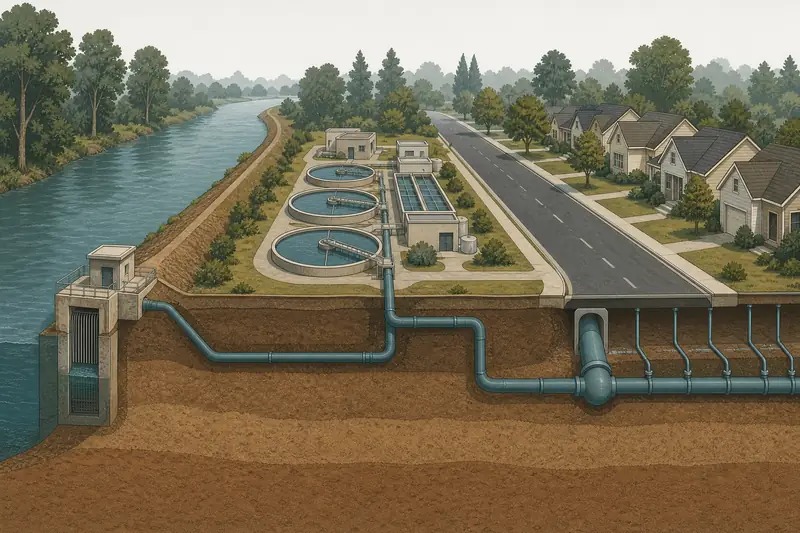
Each river has its own plant: the E.A. Fairbairn Water Treatment Plant, east of Sacramento State, treats American River water, and the Sacramento River Water Treatment Plant, north of downtown, treats Sacramento River water. The City's 2026 environmental filing for its "Water+" project describes conventional treatment at the river plant (grit basins, flocculation and sedimentation basins, filtration and finished-water storage), followed by chlorine disinfection.
That filing, posted on the state's CEQA database on July 15, 2026, also sets out planned changes. The City intends to add ozone treatment at both plants, switch from chlorine gas to sodium hypochlorite, and raise the Sacramento River plant's capacity from 160 to 235 million gallons a day. Fairbairn will not grow, because withdrawals from the American River are limited. These are plans: timing depends on funding.
The plants make a measurable difference at your tap. Fairbairn water tests at 34 mg/L hardness (2.0 gpg) and 47 mg/L total dissolved solids; Sacramento River plant water tests at 63 mg/L (3.7 gpg) and 110 mg/L TDS, per the 2025 report's tables.
How much of Sacramento tap water is groundwater?
About one-fifth of Sacramento tap water is groundwater, pumped from City wells. Well water is the hardest and most mineral-rich part of the mix: the report gives City groundwater a hardness of 15–154 mg/L (0.9–9.0 gpg), sodium of 18–74 mg/L and TDS of 180–280 mg/L.
Wells also carry most of the naturally occurring metals. Hexavalent chromium in City groundwater ranges from not detected to 7.0 µg/L, under California's 10 µg/L limit, and arsenic from not detected to 4.3 µg/L, under its 10 µg/L limit. The chromium 6 and PFAS page covers those rules in more detail.
Because wells and river water mix in the pipes, the report's system average of 83 mg/L (4.9 gpg) is a blend. On the USGS hardness scale, that is moderately hard; homes nearer a well field may read higher on some days. The hardness section explains what that means for kettles and water heaters.
Why does river water taste earthy in late summer?
An earthy or musty taste, most often in late summer, comes from geosmin and 2-methylisoborneol (2-MIB), compounds made naturally in rivers. The City's 2025 report says they "are not removed through conventional water treatment" and do not affect safety, and suggests chilling the water to improve the taste.
Chlorine is the other taste most people notice. The City keeps a free chlorine residual of 0.2–1.4 mg/L in its pipes (0.8 average), well under the 4.0 mg/L maximum. The City suggests chilling tap water to improve its taste; the chlorine taste page compares carbon filters if you want more.
The report also covers algal toxins: the City monitors the rivers for microcystins and cylindrospermopsin from summer through late fall, and found none in 2025.
Do the suburbs get the same water?
No: many suburbs get water from different plants and different rivers, and a few rely mostly on wells. West Sacramento treats its own Sacramento River water from an intake at Bryte Bend; its latest report on the City of West Sacramento's report page is still the 2024 edition, which puts hardness at 47 mg/L on average.
East of the City, Folsom Lake is the common source. The San Juan Water District's 2025 joint report gives its treated lake water a hardness of 17 mg/L, and that water also supplies Orange Vale, most of Citrus Heights and most of Fair Oaks. Folsom, Roseville and El Dorado Hills treat Folsom Lake water at their own plants. Davis and Woodland share a Sacramento River plant run by the Woodland-Davis Clean Water Agency, which also uses ozone and chlorine.
North of the City, Rio Linda/Elverta draws only from wells, and Sacramento Suburban Water District blends its wells with bought river water. The Levee Line supply overview lists every district with its source.
Is Sacramento tap water safe to drink?
The City's 2025 report states that its water "meets or exceeds all federal and state drinking water standards," and that the City was in compliance with the Revised Total Coliform Rule throughout 2025. The City tests for more than 100 substances and prints only those detected at or above reporting levels.
The lead figures are the ones most people look for. In the City's 2023 tap sampling, the 90th-percentile lead result was not detected, from 56 homes, with none over the 15 µg/L action level. The City's lead page says its 2024 inventory found no lead or galvanized-requiring-replacement service lines. Lead can still come from older faucets and solder inside a house; the report suggests running a tap for 30 seconds to 2 minutes after it has sat for hours.
For PFAS, the 2025 report prints no results; the City's PFAS page says sources over regulatory levels are taken out of service. Reports list ppm, ppb and ppt: ppm equals mg/L, ppb equals µg/L and ppt equals ng/L. To read every row yourself, see how to read a water quality report.
Sounding notes
This page is built on the City of Sacramento's 2025 Consumer Confidence Report (2025 data, published June 1, 2026), the state's Drinking Water Watch record for system CA3410020, the City's lead and PFAS pages, and the Water+ project notice on the state CEQA database (July 2026), all read in October 2026. Neighboring suppliers' sources come from their latest reports: 2025 for most, 2024 for West Sacramento. Left out: plant capacities beyond the City's own filing, older reports, and any figure the reports do not print, such as PFAS values for City water.
Downstream questions
Does Sacramento tap water come from Folsom Lake?
Partly. American River water treated at the Fairbairn plant flows down from Folsom Dam, but the City draws it from the river in Sacramento rather than from the lake itself. Suburbs such as Folsom, Roseville and the San Juan family of districts take water from Folsom Lake directly.
Why is my water softer in winter than in summer?
In many systems the river share rises when demand is low and wells run more in summer. Carmichael's 2025 report, for example, says its four primary wells run May through September. Because well water is harder, the tap often reads harder in the warm months.
Is the earthy taste a sign of contamination?
No. The City's 2025 report traces it to geosmin and 2-MIB, natural compounds from the rivers, and says they do not affect safety. Chilling the water helps.
Does Sacramento add fluoride to its water?
Yes. The 2025 report gives treated water an average of 0.7 mg/L fluoride, with a range of 0.2–1.0 mg/L, under California's 2.0 mg/L limit.
Does Sacramento use chloramine?
The City's 2025 report lists chlorine as its disinfectant, averaging 0.8 mg/L, and lists no chloramine. Every other Sacramento-region report read for this site names chlorine too.
Is the City building more treatment capacity?
It plans to. The City's 2026 Water+ filing would raise the Sacramento River plant from 160 to 235 million gallons a day and add a secondary river intake, with an ultimate 310 million gallons a day by 2050; timing depends on funding.
How often does the City publish a new report?
Once a year. The 2025 edition was published June 1, 2026, and the City says it stays the current report until June 2027.
Further down the channel
Back upstream: every Sacramento-region tap water reading