Water Pressure Regulators in Sacramento Homes
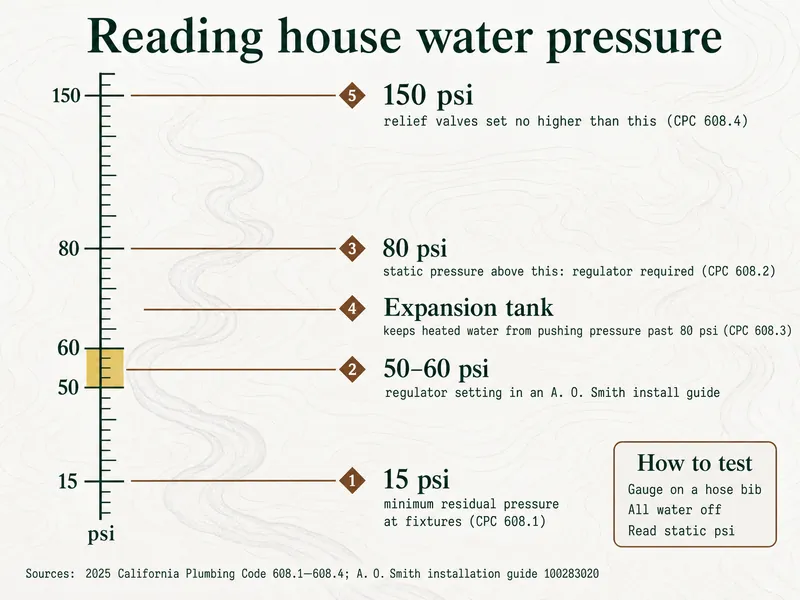
A water pressure regulator is required once static pressure at the house tops 80 psi under the 2025 California Plumbing Code, and a gauge on a hose bib tells you which side of that line you are on.
Checked against its sources by Levee Line · how figures are sourced · Last checked
Readings first
- California Plumbing Code 608.2 (2025 edition) requires a pressure regulator with a strainer where static pressure in the supply piping exceeds 80 psi, set to 80 psi or less (IAPMO 2025 CPC).
- The same code sets a 15 psi minimum residual pressure at fixtures (608.1) and calls for an expansion tank where heated water could push pressure past 80 psi (608.3).
- A. O. Smith's water heater installation manual says to set the regulator "between 50 and 60 psi" and to watch a gauge over 24 hours, since pressure often peaks at night (A. O. Smith).
- The City of Sacramento designs for at least 30 psi at every service connection at peak hour and its water study manual says to install a regulator if service pressure is over 80 psi.
- Sacramento County's improvement standards run distribution mains at 35 to 90 psi, so some homes sit above the 80 psi line.
- Davis targets 45 to 55 psi in its mains and notes pressure is lost at the meter and at a backflow assembly.
Pressure readings
- 80 psiStatic pressure above which a regulator is required2025 California Plumbing Code 608.2
- 50–60 psiRegulator setting in an A. O. Smith heater manualA. O. Smith
- 30 psiCity of Sacramento design minimum at service connections, peak hourCity Design and Procedures Manual Section 13
- 35–90 psiOperating range for County distribution mainsSacramento County Improvement Standards Sec. 8
- 15 psiMinimum residual pressure at fixtures2025 California Plumbing Code 608.1
When does a home need a water pressure regulator?
A home needs a water pressure regulator when static pressure in its supply piping exceeds 80 psi. California Plumbing Code 608.2 (2025 edition, in force January 1, 2026) says "an approved-type pressure regulator preceded by an adequate strainer shall be installed and the static pressure reduced to 80 psi (552 kPa) or less". The regulator has to meet ASSE 1003 or AWWA C530 and sit where its strainer can be cleaned.
Street pressure sets the starting point. The City of Sacramento's Section 13 design standard asks for at least 30 psi at every service connection at maximum-day peak hour, and its water study manual says "Install PRV if service pressure is greater than 80 psi." Sacramento County's improvement standards (July 1, 2025) run distribution mains between 35 and 90 psi, so a house low on a hill or near a pump station can see more than 80.
Many houses already have a regulator just downstream of the main shutoff, often a bell-shaped brass valve with an adjusting screw on top. A home with no regulator and normal readings does not need one.
How do you test water pressure?
You test water pressure with a screw-on gauge at an outside hose bib while no water is running anywhere in the house. That reading is static pressure, the figure the plumbing code uses. A. O. Smith's manual for its gas water heaters says to connect the gauge "to an outside faucet and measure the maximum water pressure experienced throughout a 24-hour period", adding that "highest water pressures often occur at night".
- Turn off irrigation, the washer, the dishwasher and every faucet; make sure no toilet is refilling.
- Thread the gauge onto the hose bib nearest the meter and open the bib fully.
- Read the dial. A gauge with a lazy red hand records the peak if you leave it overnight.
- Repeat in the early morning, when neighborhood demand is lowest and pressure tends to be highest.
A reading over 80 psi is a code issue. A reading that drifts upward after the water heater runs points to thermal expansion, covered below. Readings well under 40 psi everywhere in the house are worth a call to your supplier, since most design standards above aim higher than that.
What are signs a pressure regulator is failing?
The plainest sign of a failing regulator is a gauge reading above its set point, often creeping toward full street pressure. A. O. Smith links high pressure to replaced toilet fill valves, water heater leaks and appliance repairs, and says that in some homes "pressures can exceed 100 psi". Banging pipes when a valve closes, dripping faucets and a relief valve that weeps can all follow.
A regulator can also fail the other way. A clogged strainer or worn seat can choke flow so showers weaken when a second fixture opens. The 2025 code requires the strainer to be "readily accessible for cleaning", which is often the first thing a licensed plumber checks.
What causes low water pressure?
Low pressure in one fixture usually traces to that fixture, while low pressure everywhere traces to the regulator, a valve or the service line. Clogged faucet aerators and shower heads, a main shutoff left partly closed after repairs, and a failing regulator are the common household causes. Old galvanized pipe on the owner's side can narrow inside over decades, which is one more reason to know what your service line is made of.
Devices on the line take a share too. The City of Davis water FAQ says "some pressure is lost at the meter" and that pressure "can also be lost at the backflow if your property has one". Homes with an irrigation or fire line assembly can read the backflow testing page for that side of it. Mineral scale, more common on the groundwater systems listed under hardness by water district, can also narrow aerators and valve seats.
Who adjusts or replaces a water pressure regulator?
The regulator is on the owner's side of the meter, so the owner arranges any adjustment or replacement, usually through a licensed plumber. In the City of Sacramento, the Onsite Design Manual puts everything on the house side of the point of service in private hands, and the code requires a regulator meeting ASSE 1003 or AWWA C530.
Adjusting is done with the screw on top of the regulator while watching a gauge, and A. O. Smith's manual treats it as an owner task with a target of 50 to 60 psi. Replacing one means cutting into the main line, and work on supply piping may need a permit from your city or county building department. Your supplier controls street pressure only, not the regulator.
What is thermal expansion?
Thermal expansion is the rise in pressure when a water heater warms water in a plumbing system that has no way to push the extra volume back to the street. A. O. Smith explains that check valves and backflow preventers, "often installed in water meters", make most systems "closed", so "almost all homes now need a Thermal Expansion Tank". A toilet that runs briefly at night for no clear reason can be a symptom, the manual says.
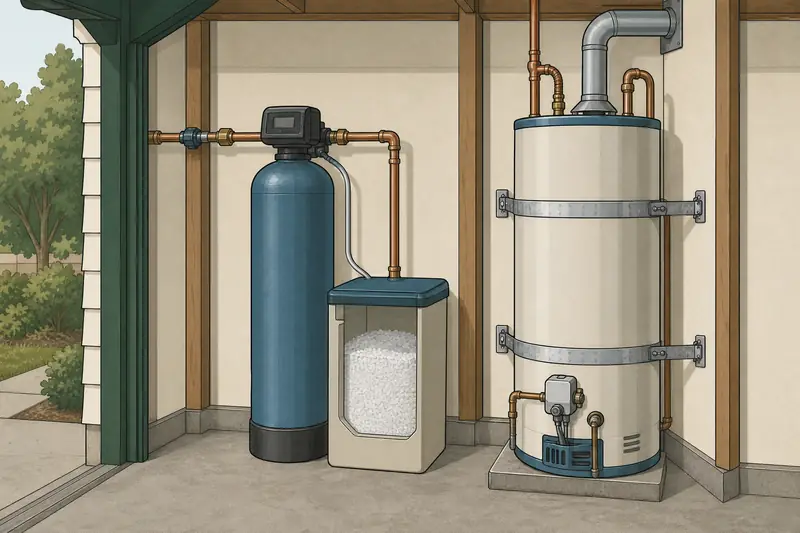
California Plumbing Code 608.3 calls for an expansion tank downstream of the regulator so thermal expansion cannot push pressure past 80 psi, and 608.4 caps relief valve settings at 150 psi. The tank is a small bladder tank on the cold line near the heater, sized to the heater's capacity. Heater upkeep, from draining to earthquake straps, is on flushing and strapping, and the other street-to-house topics sit on the Lines and pipes hub.
Sounding notes
Based on the 2025 California Plumbing Code sections 608.1 to 608.4 (IAPMO's official edition, read in October 2026); the City of Sacramento Design and Procedures Manual Section 13 (rev. July 24, 2018), its 2018 water study manual and its current Onsite Design Manual; Sacramento County Improvement Standards Section 8 (July 1, 2025); the City of Davis water FAQ; and A. O. Smith's residential gas water heater manual 100283020. Left out: supplier-by-supplier street pressure figures, which no Sacramento supplier report prints; prices for gauges, regulators or labor; and any brand recommendation.
Downstream questions
What is normal water pressure for a Sacramento house?
No supplier in the region prints a house-by-house figure, but the design numbers bracket it. The City of Sacramento designs for at least 30 psi at peak hour, County mains run 35 to 90 psi, and the plumbing code caps static pressure in the house at 80 psi. A. O. Smith suggests a regulator setting of 50 to 60 psi.
Is 90 psi too high for a house?
Yes, under the 2025 California Plumbing Code. Static pressure above 80 psi requires a regulator that brings it to 80 psi or less. A. O. Smith links high pressure to heater leaks and worn toilet valves.
Does the City of Sacramento install pressure regulators on homes?
No. The regulator is part of the private plumbing on the house side of the City's point of service, per its Onsite Design Manual. The City's water study manual tells designers to add one where service pressure is over 80 psi.
Why does my water pressure rise at night?
Neighborhood demand drops overnight, so less pressure is lost in the mains. A. O. Smith's manual says the highest pressures often occur at night and suggests leaving a gauge on for 24 hours. Thermal expansion after the heater fires can add to it in a closed system.
Can a backflow assembly lower my water pressure?
Yes, some. The City of Davis says pressure can be lost at the backflow assembly if a property has one. Assemblies on irrigation lines affect only that line.
Does a home with a pressure regulator also need an expansion tank?
Usually. California Plumbing Code 608.3 calls for an expansion tank downstream of the regulator to keep thermal expansion under 80 psi. A. O. Smith says almost all homes now need one because check valves make systems closed.
How long does a pressure regulator last?
None of the codes or manuals read for this page gives a service life. Check pressure with a gauge once a year; a reading drifting above the set point is the sign that matters.
Further down the channel
Back upstream: every Sacramento-region tap water reading